
From Discount to Discovery: The italist Case Study
When I joined italist, I knew there was a real opportunity to reposition and elevate the brand—from what it was leading with to where its real advantage lived.
The business was five years old. The founders had established a smart and viable business model in a crowded space. Their investments had been in technology and logistics—the correct approach to ensure they could actually deliver on what they promised.
The Problem
Up to that point, the marketing strategy was based solely on the pricing advantage of buying directly from Italy. Savings was the primary value proposition—from 10-50% less than local retail pricing for brands like Bottega Veneta and Saint Laurent.
But trust was a huge hurdle. Shoppers doubted italist was legitimate and the items we sold were authentic—a holdover from the eBay resale scam era in online shoppers’ minds.
What italist was missing was a compelling brand story—something to address transparency concerns while keeping buyers around and engaged beyond just saving money.
Loyalty for retailers is notoriously difficult, given that so many retailers carry the same products and brands, and brands prefer to capture as much of that business directly, rather than through a wholesale distribution model. For a given Gucci bag, there are lots of places to source it with different pros and cons.
Marketing courses at SDA Bocconi during my MBA taught me that establishing a brand strategy solely on price advantage would always fail, because in the competitive nature of capitalism, someone will always find a way to undercut your pricing.
Competing on price alone is a race to the bottom—as we’ve seen in the evolution of retail, from mall staples and main street storefronts to IKEA and Amazon in the 2010s, now to players like Shein and Temu—which offer low-quality disposable fashion and household goods for pennies.
First, I worked with the CEO and cofounders to establish an authentic brand identity with more meaning—values, pillars, mission, vision, and language. These informed our content themes, channel strategies, and a connected approach across awareness, acquisition, and retention.
The Solution
From there, our marketing and communications strategy evolved, from placing price advantages and savings as our top message to positioning italist as a curator and a platform for discovery—a destination for savvy shoppers with a taste for Italy’s finest things and a preference to shop from the comfort of home.
“Why go to Italy to shop like Italians do? Browse and shop from Italy’s best independent boutiques, enjoy free worldwide express shipping, and save up to 50%!”
We carried the same brands found at Nordstrom, Neiman Marcus, and Saks Fifth Avenue, but our “buy” was uniquely Italian—driven by the veteran buyers at Italy’s best independent fashion boutiques, some of whom helped launch the careers of designers we take for granted today like Dolce & Gabbana and Versace.
Unlike other parts of the world, department stores are less prominent in Italy. Instead, the country’s cities and towns have independent, multi-brand luxury boutiques—250 of them, in towns like Bari and Forte dei Marmi, were our partners and the source of our enormous inventory.
Another wrinkle we faced: the products and brands we carried were the terms shoppers were searching for and the entry point to our site, not people searching for ‘italist’. We addressed these high-competition search terms by instead developing content around the questions people were asking about brands (like sizing) rather than trying to compete for keywords and phrases.
How We Executed It
Over five years our narrative evolved dramatically.
To boost awareness, industry recognition, and ultimately encourage an acquisition, we engaged top fashion and business journalists to discuss not only our expansive array (over 200,000 listings), but our unique curation and the business model we’d pioneered—sourcing from small retailers and partnering with DHL to manage logistics while carrying no financial inventory risk.
To address legitimacy concerns to shoppers, we invested heavily in managing our online reviews and created content flows addressing common concerns about how our platform worked, our sourcing standards, and our shipping and returns policies.
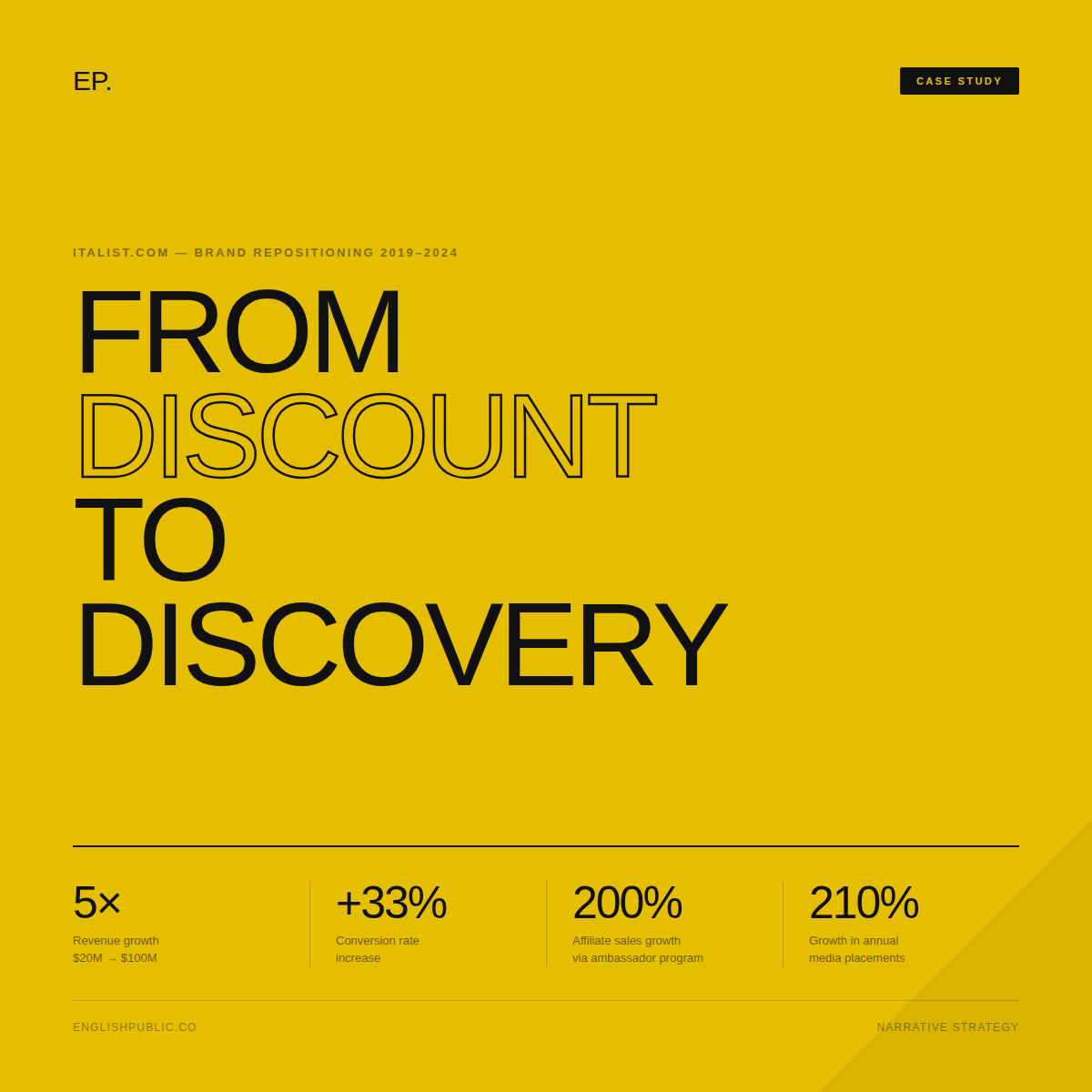
We also established an ambassador program, turning a small group of passionate customers into empowered italist evangelists. By the time I left we had over 600 ambassadors earning commissions on sales they generated—contributing to a 200% increase in affiliate-driven sales over two years.
To engage our audience beyond just price comparing and browsing, we established storytelling pillars: the product knowledge and expertise of our partner boutiques, the quality and excellence of niche Italian labels only we carried, and interviews with Italian influencers and Hollywood stylists about good style. We were, after all, sitting in Los Angeles, one of the world’s most stylish cities.
We also invested in a visual brand overhaul, which gave us a refreshed logo, font families, and editorial templates to follow.
Eventually, “savings” as a brand driver became the initial hook to get people curious and a happy byproduct—not the top level message about who we were and why people should care.
Toward the end of my time at italist, before AI became mainstream, we were early adopters of marketing personalization at scale. Using Klaviyo, our email mix gradually transitioned from generic to highly-specific, rooted in triggered email flows based on actions users took on our website and mobile app.
Eventually our general email campaigns and mobile app push notifications became solely for major sale announcements and updates, geared toward those in our million-plus email list who’d yet to establish a purchase history or wishlist.
For established customers, we supercharged product “discovery” by taking their shopping data and generating arrays of items we predicted they might like—in adjacent categories from a single brand, the same category of items from similar brands, or easy add-ons within the same style universe (e.g. luxury, classic, streetwear) or similar price point.
Personalized email campaigns showed a 50% improvement in revenue per recipient vs. generic, “spray and pray” campaigns.
Across the business, we also saw a 33% improvement in our overall conversion rate.
Results & Competition
In just under five years, in the role of Head of Marketing, I helped italist grow from $20 million in annual sales to over $100 million. Shortly after, the company was acquired by Inspiration Commerce Group.
Given that our average transaction was about $600, it was impressive growth for an ecommerce retailer with zero brand recognition, selling other brands, and balancing the competing priorities of being luxurious and aspirational, a destination for savings, and a legitimate player in the high-end fashion retail space.
COVID-19 was a huge boon to our business, as we never had to shut down warehouses and had a remote workforce. But the boom times also introduced countless copycats like Cettire and Baltini, both of which replicated our business model, borrowed our brand aesthetic (black and white), and worked with our same inventory suppliers (retailers in Italy) so they carried the same items, often with identical images to what we had on our site.
Cettire, based in Australia, grew rapidly by aggressively acquiring customers, advertising across digital media, paying for press coverage, and undercutting our pricing just enough to be enticing—even though they’d started later and had no brand beyond a generic Instagram account.
They IPO’d in late 2020 and have experienced extreme market volatility since.
Italist never IPO’d, instead opting for a slow and steady approach and a private acquisition. Other than some relatively small initial investments from the founders and Silicon Valley accelerators like 500 Startups, italist was conservative, cash positive, and avoided the unnecessary pressure of the traditional venture capital path.
A 5x revenue increase, a clean acquisition, and no venture capital pressure—by most measures, it worked.
